

When a food or drink brand enters a new market, three things change on the pack: what the law says the label must carry, what shoppers there expect to see, and how the product reaches the shelf. The idea behind the brand should stay the same. This guide walks through each change for the USA, the EU and the UK, with two projects where a brand had to earn its place in a market that was not its own: Tissir coffee in Belgium and Bab Marrakesh in the UAE.
What should not change: the idea
A new market is a reason to rethink the label. It is rarely a reason to become a different brand.
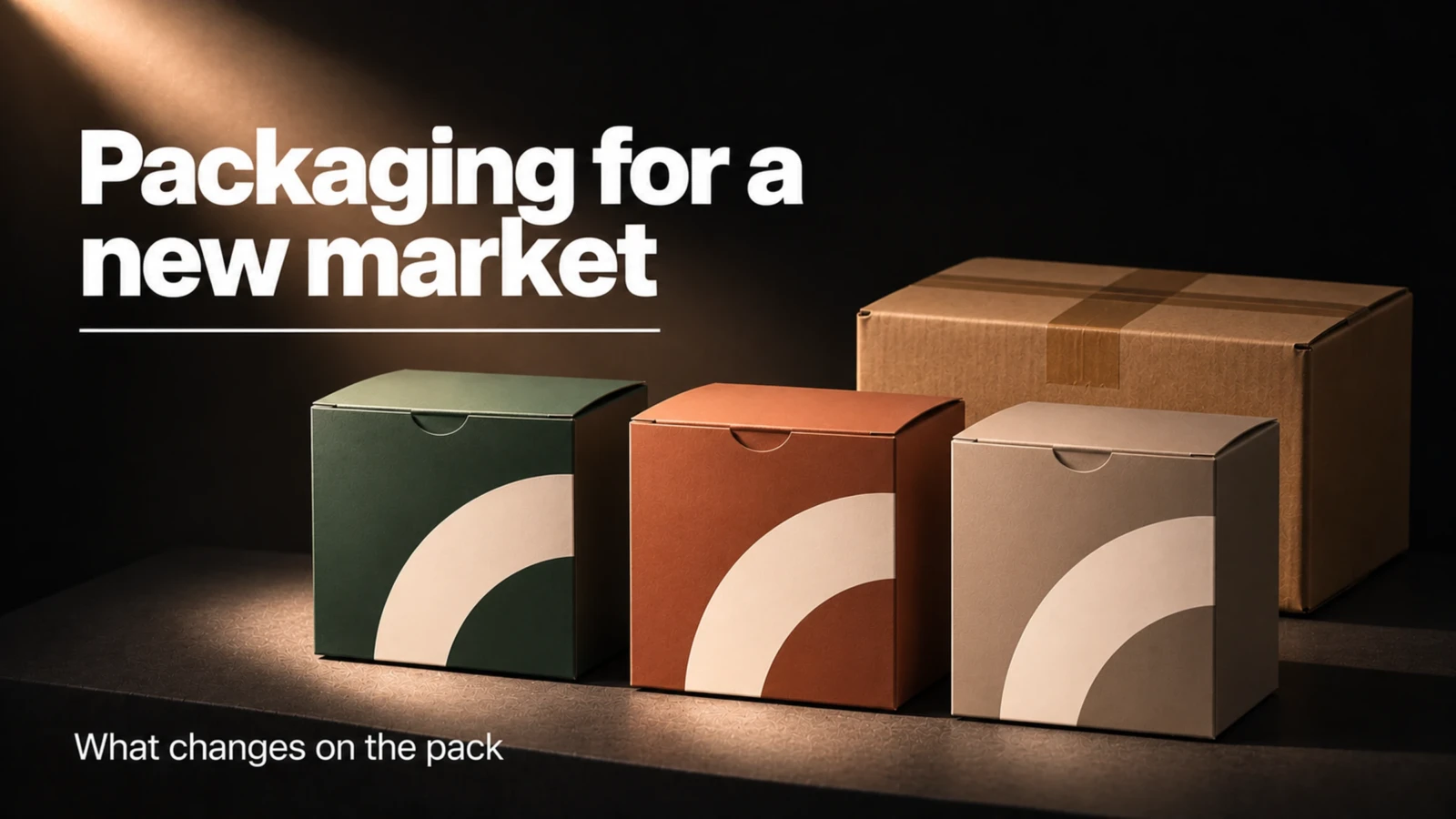
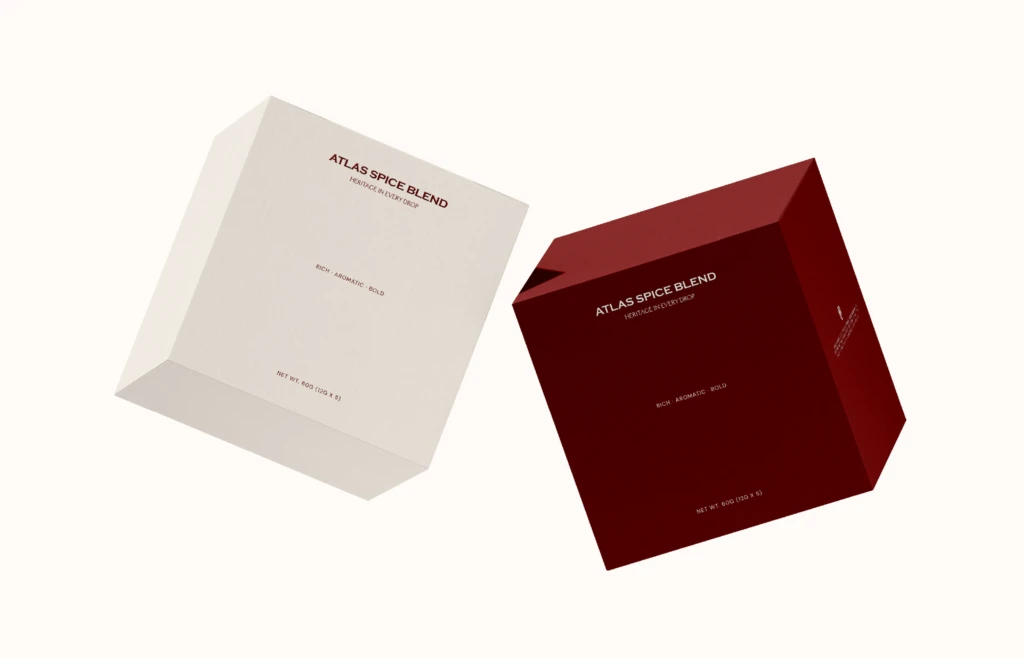
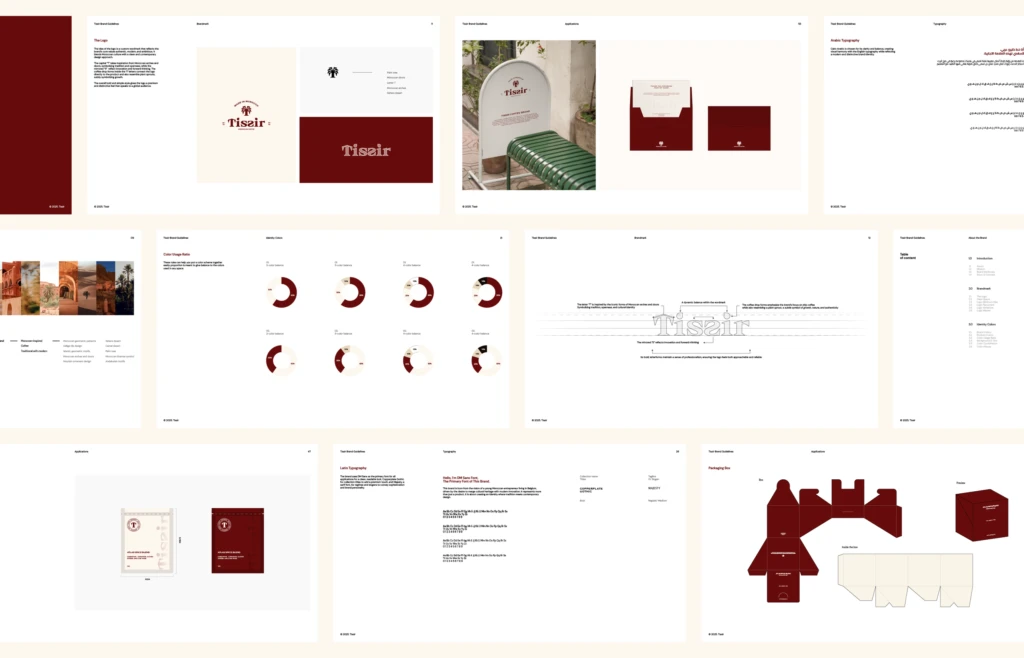
Tissir is a specialty coffee brand launched in Belgium by a Moroccan entrepreneur. The first collection is a Moroccan-spiced drip coffee. The easy route was the tourist version of Morocco: lanterns, camels, busy ornament. The brief ruled that out. So the pack is Moroccan in its structure and quiet on the outside. A minimal box in deep crimson or forest green opens to a warm sand interior lined with spice botanicals, and the capital T of the wordmark takes its shape from Moorish horseshoe arches.
Aya, the founder, put it this way: “We needed to bring Moroccan coffee to Europe without relying on clichés. We Craft Studio perfectly balanced modern minimalism with our heritage, delivering a packaging system that wins over high-end international retailers.”
Keep the idea. Change what the new market needs changed.
What the law changes on the label
Label rules are the part founders underestimate, because they look like small print. They are small print that takes up real space, and that space has to be designed.
Here are the main differences a designer has to plan for. They come from the official guidance linked below the table.
| USA | EU | UK (Great Britain) | |
|---|---|---|---|
| Allergens | 9 major allergens. Declared in brackets after the ingredient or in a “Contains” line | 14 allergens. Emphasised inside the ingredient list, for example in bold | 14 allergens, listed with the ingredients |
| Net quantity | In both metric and US customary units | Metric | Metric |
| Language | English. If another language appears anywhere on the label, every required statement must appear in both | A language shoppers in that country easily understand. Each country sets its own rule | English |
| Business address | Name and address of the manufacturer, packer or distributor. Imported food also states the country of origin | Name and address of the business in the EU, or of the importer | A UK address for the business, or for the UK importer (since 1 January 2024) |
| Minimum type size | 1/16 inch for the information panel | 1.2 mm x-height (0.9 mm on very small packs) | 1.2 mm x-height (0.9 mm on very small packs) |
| Nutrition | Nutrition Facts panel in the FDA format | Nutrition declaration | Nutrition information |
Sources: the FDA Food Labeling Guide and the FDA page on food allergies for the USA, the EU’s general food labelling rules, and GOV.UK food labelling guidance for the UK. Food sold in Northern Ireland follows the EU rules.
Two limits on this table. Rules change, and some products (drinks with caffeine, supplements, organic claims, anything with a health claim) have extra rules of their own. And a design studio is not a regulatory adviser. Your importer, distributor or a food labelling consultant should approve the final wording. Our job is to design the pack so the approved text fits and still reads well.
What that does to the design
Three practical effects.
The information panel grows. A US pack needs a Nutrition Facts panel in a fixed format and a net quantity in two unit systems. An EU pack sold in three countries may need three languages. We plan the information panel from the first sketch, so it is not squeezed in at the end. The text stays readable but quiet, so the front of the pack does the selling.
Languages have to be designed, not pasted in. A second language is a second layout problem. On an Arabic and English pack, the Arabic is set in a real Arabic typeface and the two scripts are designed together so the pack reads as one brand in both. The same care applies to French and Dutch for Belgium, or English and Spanish for the USA. Note the US rule in the table: if your home-market language stays on the pack for character, the required statements must appear in that language too.
One master, several market versions. The cheapest way to sell in several countries is one master design with a planned zone that changes per market. Decide early which elements never change (the mark, the colors, the front layout) and which change per country (languages, units, address, nutrition panel). Then a new market is a new version of one file, and you avoid a redesign.
What shoppers expect
Every market has its own shelf. Before designing, we look at the shelf your product will sit on in the new country: who is already there, what the category looks like, and what would make a buyer notice yours without it looking out of place.
A product that looks premium at home can look ordinary abroad. Bab Marrakesh sells Moroccan products online in the UAE. People loved the products, but the old identity fell short of the premium standard that market expects, and the store was selling in Dubai next to platforms like Noon. We rebuilt the brand with a bilingual Arabic and English identity, a clearer brand story and a new website. In the first three months after launch, revenue grew 366%, and monthly revenue went on to reach $12,000, up from $720 before the rebrand (figures reported by the client).
The lesson applies in any direction. A European brand entering the USA, or an American brand entering the UK, meets a shelf with different codes for “premium”, “natural” or “good value”. Check the shelf first.
We have designed packaging for brands in the USA, the UK, Belgium and the Netherlands, including Purewake, Sahari Skin, Tissir and Mbioo Care.
How the product reaches the shelf
The sales channel changes the pack as much as the country does.
- Supermarket shelf: a shopper looks briefly, from close up, and decides. The brand, the flavor and the reason to buy come first.
- Wholesale and food service: the pack gets stacked, carried, scanned and stored. It has to be strong, easy to read from a distance and clear on the basics.
- Online: the pack is seen first as a small image on a screen, then in the customer’s hands when the parcel is opened. Both moments count.
There is also the printer. If the product will be printed or packed in the new market, the dieline and the file requirements come from that printer. We work the dieline out with the client’s printer, because each one has its own machines and tolerances.
Before you brief a designer: six questions
- Which countries, in which order? Design the master for all of them from the start.
- Who is your importer or distributor in each one? Their name and address go on the pack.
- Where will it be sold: supermarkets, specialty stores, wholesale, online?
- Who prints it, and where?
- Who approves the label text for each market?
- What must never change about the brand, wherever it is sold?
If you can answer these in the project brief, the first call goes faster. If you can’t yet, that is normal, and the first call is where we work them out.
Mistakes we see
- Translating the home-market pack and shipping it
- Leaving the legal text for the end, then shrinking it until it fits
- Designing before the importer and the printer are known
- Leaning on clichés about the country of origin
- Redesigning from zero for every country, so the brand looks different in each one
Taking a food or drink brand into a new market and want packaging design that is planned for it from the first sketch? Start a project with a short brief, or book a call.
Frequently asked questions
Do I need new packaging to sell in another country?
Usually you need a new version, not a new design. The label has to meet local rules for language, allergens, units and the business address. The brand idea and the front of the pack can stay.
What has to be on a food label in the USA?
The name of the food, the net quantity in metric and US customary units, a Nutrition Facts panel, the ingredient list, the major allergens, and the name and address of the manufacturer, packer or distributor. Imported food also states its country of origin. The FDA Food Labeling Guide has the detail.
What has to be on a food label in the EU and the UK?
The name of the food, the ingredients with allergens, the net quantity, a best before or use by date, the name and address of the business or importer, and nutrition information. Mandatory text has a minimum size of 1.2 mm x-height. Language rules depend on the country.
Can one pack work for several countries?
Yes, if it is built as a master design with a planned area that changes per market. A pack for neighbouring countries often carries two or three languages.
Who checks that the label is legal?
Your importer, distributor or a food labelling consultant. The designer’s job is to make the approved text fit and stay readable while the pack still sells.