Your product has a few seconds. A shopper walks down an aisle, scans a wall of competing brands, and makes a decision almost without thinking. In that moment, your packaging is not decoration. It is your best salesperson, working alone, with no second chance.
So what separates packaging that sells from packaging that blends in? After designing packaging systems for food, coffee, beauty and retail brands across Europe, the Gulf and North Africa, we keep coming back to the same seven principles.
1. Win the first glance with one strong signal
On a crowded shelf, nobody reads first. They notice. The packages that win have one dominant visual signal that can be recognized from a distance: a bold color block, a distinctive shape, a pattern, or a mark.
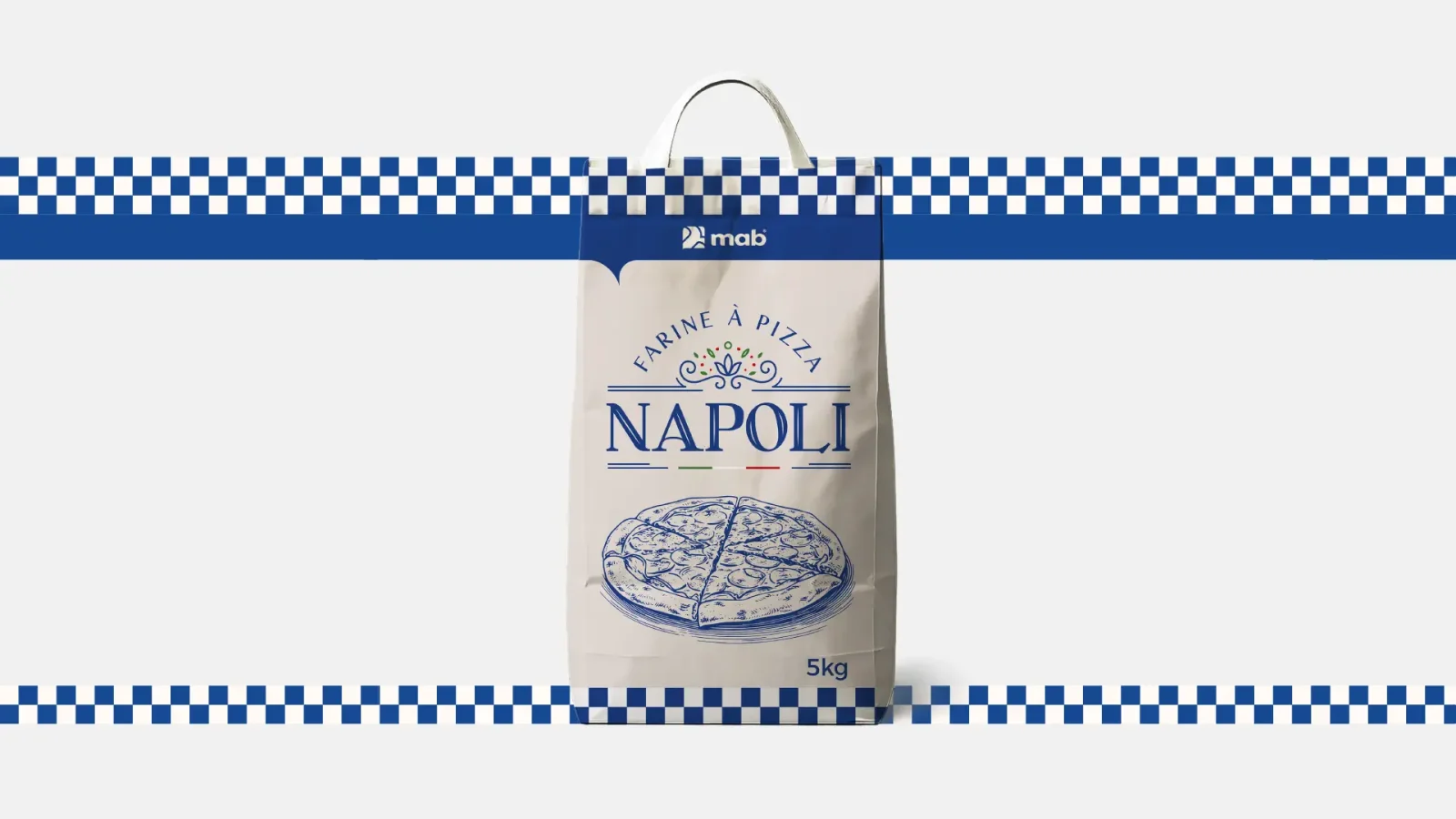
For Napoli, a professional pizza flour brand, that signal is a cobalt and white checkered border framing the top and bottom of every bag. It references classic Italian trattoria tablecloths, and it is impossible to miss in a wholesale environment full of plain bulk sacks. One idea, executed boldly, does more than ten competing details.
Ask yourself: if someone saw your package from five meters away for one second, what would they remember?
2. Make the hierarchy obvious
Once a shopper is curious, they need to understand the product instantly. Good packaging has a clear reading order:
- The brand (who is this?)
- The product (what is it?)
- The key benefit or variant (why this one?)
When everything shouts at the same volume, nothing is heard. Decide what matters most, make it the biggest, and give the rest room to breathe.
3. Design for the category, then break one rule
Every category has codes. Shoppers expect certain colors, materials and cues for coffee, cosmetics or flour. Ignore all of them and people may not even understand what you sell. Follow all of them and you disappear into the crowd.
The smart move is to respect the codes that build trust, then break one deliberately. Tissir, a specialty coffee brand bringing Moroccan coffee culture to Europe, avoided the usual clichés of the category. Instead of tourist imagery, the packaging uses a minimalist exterior in deep crimson or forest green that opens onto a warm, textured interior. Familiar enough to read as premium coffee, different enough to be remembered.
4. Turn opening the box into a moment
Packaging does not stop working once it is bought. The unboxing is where a customer decides whether your brand feels worth it, and where they decide whether to share it.
A considered reveal, an interior surprise, a texture change, or a message inside the lid costs little and creates a lasting impression. For direct-to-consumer brands especially, the unboxing is often the first physical contact with the brand. Treat it like a first meeting.
5. Build a system, not a single pack
Most brands do not sell one product forever. New flavors, sizes, collections and limited editions will come. If your packaging is designed as a one-off, every new product becomes a new design problem, and your shelf presence slowly turns into chaos.
Design a system instead: fixed elements that always stay the same (logo position, typography, structure) and flexible elements that change per variant (color, illustration, pattern). For Luma Socks, we built collection-specific packaging and special edition boxes that all live in one unified visual language. Each collection has its own mood, yet the brand is always instantly recognizable.
6. Respect production from day one
Beautiful packaging that cannot be produced at a reasonable cost is not beautiful. It is a problem.
Material choices, print methods, finishes, dielines and supplier constraints should shape the design early, not get discovered at the end. A design that looks perfect on screen can lose its magic on uncoated board or a flexible pouch. Working with print-ready artwork and real dielines from the start protects both the design and the budget.
7. Tell the same story everywhere
Your package is one touchpoint among many: the website, social media, ads, the retail display, the delivery bag. When the packaging tells a different story than the rest of the brand, trust drops.
The strongest brands feel consistent wherever you meet them. That is why we always design packaging as part of the full identity, not as a separate project.
The bottom line
Packaging design that sells is not about adding more. It is about one strong signal, a clear hierarchy, smart use of category codes, a memorable reveal, a scalable system, production reality and a consistent story.
If your packaging is blending in, or you are about to launch a new range, we would be happy to take a look. Book a free 30-minute discovery call or see our packaging work.